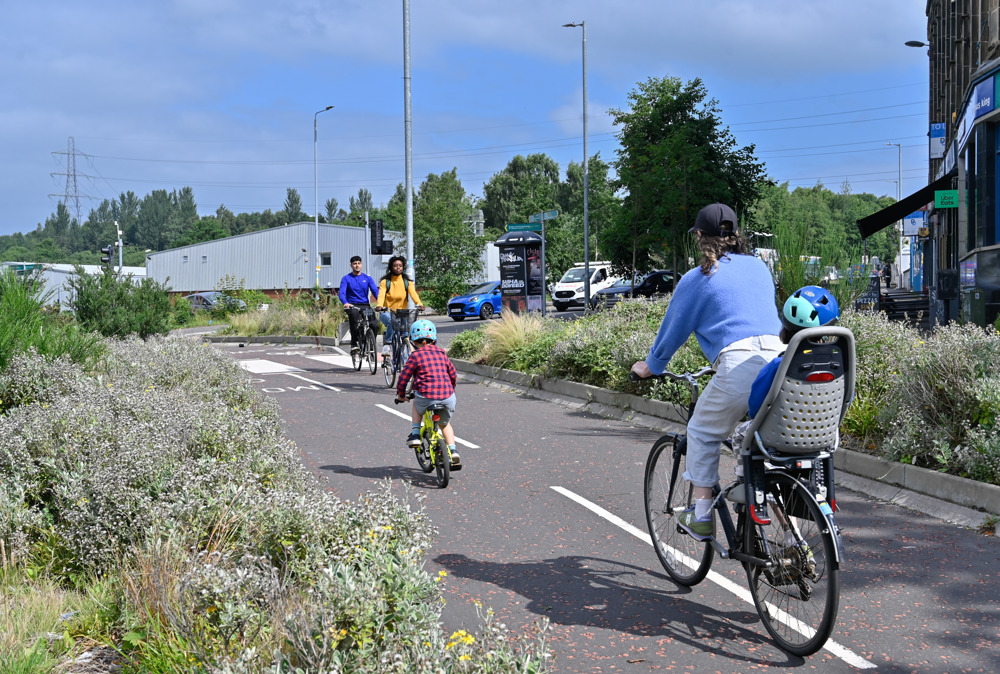
Latest analysis of traffic survey and cycle counter data shows thousands of people cycling at locations across Scotland, with much of it linked to investment in safe cycle lanes.
September 2025 traffic surveys show continued impact of new cycling infrastructure
Data captured in the most recent wave of 48-hour traffic surveys carried out by Cycling Scotland in September 2025, shows yet more growth in people travelling by bike where new, high-quality, corridors for cycling have been provided.
Over the two-day survey period on 24th and 25th September 2025, traffic surveys recorded 5,287 bikes on the South City Way cycle route on Victoria Road in the south of Glasgow. This was out of a total of 32,894 methods of travel recorded, meaning that 16.1% of people cycled their journey – a new record for the South City Way and a mode share that wouldn’t look out of place in the Netherlands or Denmark.
Comparing this result to a street without cycle lanes, Saracen Street in the north of the city showed just 1.3% of people cycling their journey.
More bikes than cars were recorded at all rush hour travel peaks over the two-day survey period on Victoria Road. Previously, this success had been achieved in one rush hour travel peak.
On Clyde Street in Glasgow city centre, 3,065 bikes were recorded over the two-day survey period, where the South City Way meets a new, protected on-street cycle lane. Bikes represented 12.1% of all journeys at this location.
In the city’s West End, 1,681 bikes were recorded over the two-day period on the bottom half of Byres Road, where phase one redevelopment works, including protected cycle lanes, are now complete. Garscube Road saw 1,636 cycle journeys recorded in the same period, where a 1km protected, bidirectional cycle lane connects Maryhill to the city centre.
Before and after slider: Gorbals Cross in Glasgow in 2016 before construction of the South City Way cycle route, and an image of the completed route in summer 2025, with many people pictured cycling home in the early evening
Katy Hastie, a Glasgow resident who uses the city’s growing network of protected cycle lanes to travel by bike, said: "It’s made a colossal difference having the protected routes. Being well separated from traffic means I’m able to travel in safety. I’d go so far as to say I wouldn’t be cycling as much for my daily commute or at all without the protected cycle lanes now in place."
"I really like that I can squeeze some fitness and fresh air into my daily routine with cycling – and how efficient it can be. Often, it’s the fastest and cheapest way to get somewhere. I like that extra five minutes in bed, the fresh air and the free workout. It makes a huge difference mentally, health-wise, is quick and mega cheap. Win-win, all round."
In Edinburgh, a growing network of cycle lanes is also seeing more people choosing to travel by bike.
Over the 48-hour survey period, traffic surveys recorded 4,744 bikes on Leith Walk. This was out of a total of 48,832 travel methods recorded, meaning that 9.7% of people cycled their journey – the highest cycling modal share yet seen on the route.
On the western-most portion of the new City Centre West East Link (CCWEL), at West Coates in Roseburn, 2,798 bikes were recorded over the same 48-hour survey period. This was out of a total of 30,175 travel methods recorded on the street, equating to 9.3% of journeys being made by bike – a new record cycling modal share for this section of route.
At York Place, where the new CCWEL protected cycle route connects to Leith Walk via Picardy Place, 1,921 cycle journeys were recorded over the two-day period. This is the largest number of bikes yet recorded at this location by a Cycling Scotland traffic survey and evidence of the growth in cycling being supported as routes join together.
At Great Junction Street in Leith, 2,023 cycle journeys were recorded, with a cycling modal share of 4.1% - both new records for this location, where new safe, protected cycle lanes are currently being installed as part of the Leith Connections project.
Michael Owen, an 89-year-old Edinburgh resident who uses his bike most days to stay fit, said: "I'm very supportive of improvements for cycling in the city. I'm approaching 90, and I use my bike to get local shopping most days. If it's a decent day I might add a mile or two onto my journey."
"I've always used my bike to keep fit, particularly to build fitness for skiing trips and sports - now it's my main way of looking after myself. It keeps me more mobile than otherwise."
"Convenience, practical reasons… it's my best form of transport. If I have any appointments, medical check-ups in the city centre for example, I'll get there by bike. I realise just how much easier it is to get around and to deal with everyday things by using my bike."
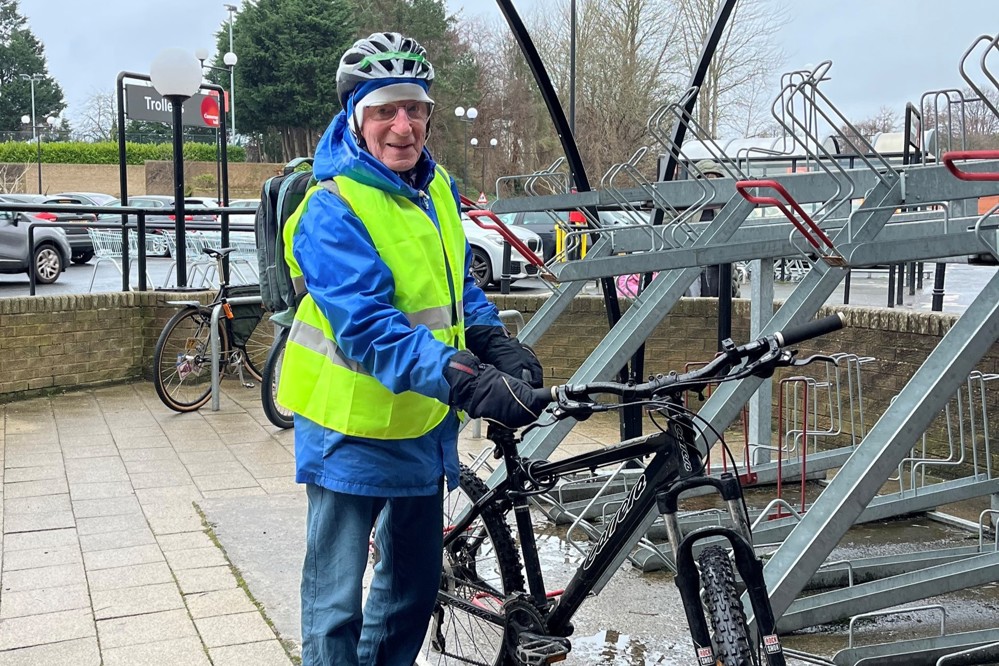
Edinburgh resident Michael Owen, 89, pictured parking his bike at his local supermarket
In Stirling, the impact of the Walk, Cycle, Live Stirling project’s protected cycle lanes can continue to be seen, with 480 daily journeys recorded on Goosecroft Road* near Stirling Rail Station in the September 2025 survey period – an increase of 11% on the year before.
Data from these traffic surveys also shows that across Scotland, where safe, protected cycle lanes are provided, the vast majority of people cycling choose to use it rather than cycling on-road.
Peaks in cycling around morning and evening rush hours indicate that a substantial portion of cycling on these routes is people making everyday journeys, such as travelling to and from work.
Cycle counters show long term increases in bike journeys since 2021
A separate analysis of data from the nationwide cycle counter network, supports this same picture of long-term increases in cycling where new safe infrastructure is being provided.
In Glasgow, several sections of the city’s expanding cross-city cycling network have seen significant increases in cycling since 2021.
13,487 cycle journeys were recorded on the South West City Way route in September 2025, compared to 6,241 in September 2021 – an increase of 116%. This follows completion of the route extension in 2024, with the protected on-street cycle lanes now running for 4km from Pollok Park to the city centre, via Pollokshields.
Nearby, a pair of counters located at the junctions of Victoria Road with Calder Street and Alison Street on the northbound and southbound cycle lanes of the South City Way, recorded a combined 131,324 cycle journeys over the full month of September 2025, compared to 70,827 over September 2021 – an increase of 85%.
At the eastern end of the city’s East City Way route, cycling levels grew by 81% from 1,246 cycle journeys in September 2021 to 2,257 in September 2025. This follows improvements made to several sections of the 8km route, which is still under development and will ultimately connect communities in the East End out to Mount Vernon, to the city centre via Glasgow Green.
In the south of Edinburgh, improvements to the junction of Gilmerton Road and the Pillars Path where two cycle routes meet – including physical protection for on-street cycle lanes and safer crossing points – have led to a 200% increase in cycling between September 2021 (1,561 journeys) and September 2025 (4,676).
Also in Edinburgh, a 20% increase in cycle journeys was recorded by counters at Bruntsfield Place (8,705 cycle journeys in 2021 vs 10,457 in 2025) and North Meadow Walk (32,292 cycle journeys in 2021 vs 38,611 in 2025) – indicating that cycling is continuing to grow in the capital.
These findings follow on from previous analysis of nationwide cycle counter data, which showed increases in cycling at locations across Scotland, including Aviemore, Irvine, Kilwinning, Motherwell and Stirling.

People cycling on Goosecroft Road in the centre of Stirling, part of the city's newly completed 'Walk, Cycle, Live Stirling' network of protected cycle lanes
City of Edinburgh Council Transport and Environment Convener, Councillor Stephen Jenkinson, said: "The data here speaks for itself. We’ve consistently seen that where we commit to creating and improving cycling infrastructure, new users will follow. From supporting more liveable local neighbourhoods, to getting physical exercise and choosing to get around more sustainably, I’d encourage anyone thinking of getting on a bike this year to give it a try.
"Under our City Mobility Plan, we’re committed to making Edinburgh as easy for people to move around as possible, and cycling is one of the key sustainable transport modes that supports this."
Convener for Transport and Climate at Glasgow City Council, said, Councillor Angus Millar, said: "These results demonstrate the growing impact of high quality cycling infrastructure across Glasgow, showing that more people are choosing the bike as an option to get about the city when safe, protected routes are provided.
"From the South City Way and Clyde Street in the city centre to Byres Road, Garscube Road, the South West City Way and the East City Way - protected routes are enabling more people to cycle safely and confidently for everyday journeys. Alongside the wider evidence base for increasing numbers of cycle journeys in the city, this is another clear indication of the growing success of Glasgow’s protected active travel network and its potential to enable more Glaswegians to choose active and sustainable travel more often."
Methodology:
- Traffic survey data collected by Cycling Scotland all-mode traffic surveys which are conducted over a 48-hour period across more than 100 sites in all 32 of Scotland's local authorities. They are conducted twice a year - in May & September.
- Cycle counters findings follow a comparative analysis of data from more than 800 automatic cycle counters covering all 32 Scottish local authorities across Scotland, including over 85 counters managed by Cycling Scotland through the National Monitoring Framework. Cycle counts from September 2021 were compared with counts from September 2025, to identify locations seeing significant increases in cycling.
- Traffic survey and counter data can be viewed and downloaded from the Cycling Open Data portal.
- *Data for Goosecroft Road is taken from a real-time AI sensor, rather than a 48-hour traffic survey, and is therefore not directly comparable with the traffic survey results.

