Annual report & accounts 2025-26

Monitoring cycling, road safety and connecting people
Monitoring everyday cycling in Scotland
Cycling Scotland collects, analyses and shares cycling data nationally, regionally and locally.
The National Monitoring Framework is a Scotland-wide project which uses fixed cycle counters and biannual all-mode traffic surveys to monitor long-term cycling rates and cycling mode shares.
All-mode traffic surveys were conducted over two days (Wednesday and Thursday) in May and September 2025 at 146 locations in all 32 local authorities. Local and regional specific results were provided to each local authority and Regional Transport Partnership, highlighting areas of significant growth in cycling. Summaries were also published on Cycling Scotland’s website.
Key findings, May 2025:
- Glasgow’s landmark South City Way cycle route saw more journeys cycled than driven during one rush hour period (8-9am) on 5th June.*
- An average of 1,375 daily bike journeys were recorded along West Coates, on the Edinburgh City Centre West to East Link. This showed an increase of 90%, compared to 725 average bike journeys per day in May 2024.
- Perth, Dunkeld Road and Ruthvenfield Road saw their highest cycling counts recorded in Cycling Scotland traffic surveys.
* Data for all sites was captured on 14th-15th May, except data for Victoria Road which was recaptured on 5th-6th June, following technical issues with the initial survey.
Key findings, September 2025:
- Trend of more journeys cycled than driven continues in Glasgow on the South City Way. More bikes than cars were recorded at all rush hour travel peaks over two-day survey period.
- Over 2,000 cycle journeys were recorded at Great Junction Street in Leith were protected cycle lanes were being installed as part of the Leith Connections project.
Results from all-mode traffic surveys in 2024 and 2025 were also presented at the Scottish Physical Activity Research Connections 2025 conference.
More bikes than cars were recorded at all rush hour travel peaks over the two-day survey period on Victoria Road, Glasgow in September 2025
Cycling Open Data portal
We continued to manage, maintain and improve the Cycling Open Data portal this year. The portal provides the most comprehensive collection of cycling data of its kind in Scotland, including real-time data from over 800 cycle counters owned by Cycling Scotland, local authorities and other partners, and data from our 48-hour, multi-modal traffic surveys. We continue to work closely with local authorities and other partners to expand the portal and make ongoing improvements to useability, making it easier for people to find data related to cycling.
We published analysis of counter data available on the Cycling Open Data Portal. It showed growth in the number of people travelling by bike in 2025 in 2025 compared with 2024 at locations including Aberdeen, the Highlands, North Ayrshire, North Lanarkshire and Stirling.
New technologies
We continued to trial artificial intelligence monitoring technologies on a small scale with a view to enhancing the National Monitoring Framework over time.
An AI sensor installed by Cycling Scotland on the projected cycle lanes on Goosecroft Road, near Stirling train station (part of Walk Wheel Live Stirling project) recorded an average of 480 daily cycle journeys at the same time as the 48-hour traffic surveys in September 2025.
The latest Annual Cycling Monitoring Report is now available as an online interactive visualisation on the Cycling Scotland website, bringing together national and local cycling statistics from multiple sources. Areas covered include participation in cycling, access to bikes, attitudes to cycling and cycle count data.
Coordination
Cycling Scotland hosted three meetings of the Cycling Delivery Forum subgroup on monitoring. The meetings bring together local authorities, Transport Scotland and Walk Wheel Cycle Trust to discuss matters relating to monitoring cycling.
Case study
More bikes than cars at rush hour thanks to protected cycle lanes
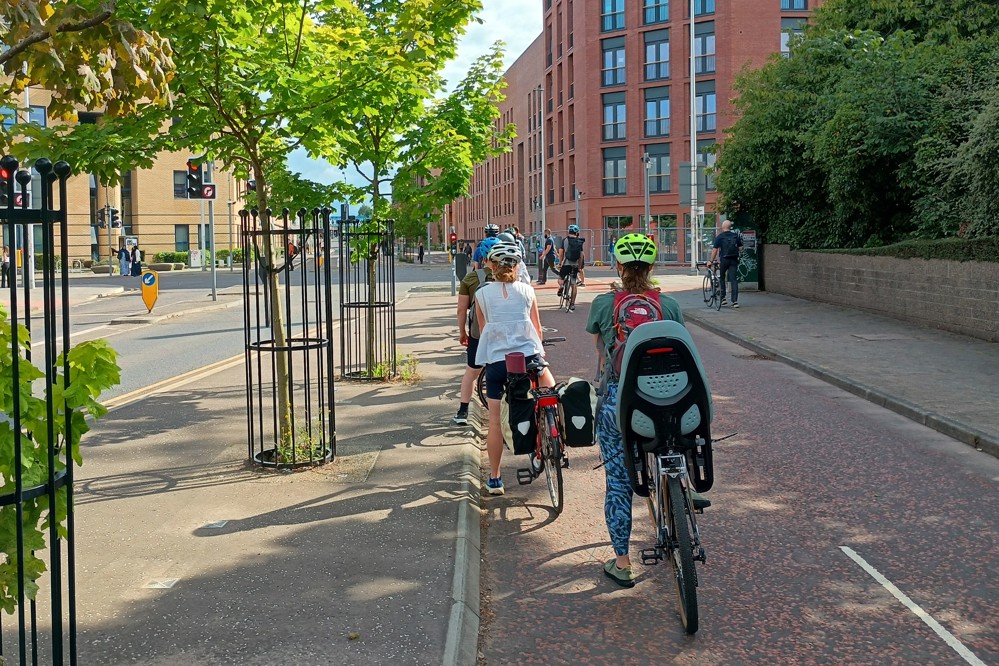
All-mode traffic surveys organised by Cycling Scotland in September 2025 revealed the continued success of a new landmark cycle route, connecting neighbourhoods to the centre of Glasgow.
Over the two-day survey period on 24th and 25th September, traffic surveys recorded 5,287 bikes in total on the South City Way cycle route on Victoria Road in the south of Glasgow. This was out of a total of 32,894 methods of travel recorded, meaning 16.1% of people cycled their journey – a new record cycling modal share for the location.
Additionally, bikes were observed to outnumber cars at peak travel hours (8-9am and 5-6pm) over the survey period – a sign of the continuing impact of this new protected cycling infrastructure.
Katy Hastie, a Glasgow resident who uses the city’s growing network of protected cycle lanes to travel by bike, said: "It’s made a colossal difference having the protected routes."
Being well separated from traffic means I’m able to travel in safety. I’d go so far as to say I wouldn’t be cycling as much for my daily commute or at all without the protected cycle lanes now in place.
Katie added, "I really like that I can squeeze some fitness and fresh air into my daily routine with cycling – and how efficient it can be. Often, it’s the fastest and cheapest way to get somewhere. I like that extra five minutes in bed, the fresh air and the free workout. It makes a huge difference mentally, health-wise, is quick and mega cheap. Win-win, all round."