Fleet bike guidance
General guidance
Price and quality
Even with regular maintenance and servicing, fleet bikes will have a tough life!
Choose good quality, robust bikes. Some parts, such as chains, gears and brake pads will wear out regardless of the price, but a good quality frame, wheels, and controls will extend the life of a fleet bike. This guidance has developed from working with organisations operating bike fleets across Scotland.
- Choose robust, quality bikes to withstand frequent use.
- Balance cost with durability and future maintenance needs.
- Quality refurbished bikes are a good a low-cost option if available locally.
- Suggested minimum recommended retail price (RRP) is at least £350 per adult bike, £250 per child’s bike (subject to market changes).
Size
A well-fitting bike inspires confidence, and control and your fleet of bikes need to include a range of sizes to suit riders of different heights and sizes.
The seat height is adjustable on most bikes. However, the handlebar height and reach (the distance between saddle and handlebars) are often fixed. Some bikes come with a quick release seat clamp, allowing the seat height to be adjusted without using a tool such as a spanner or hex key.
Where possible, buy from the same range to allow easy maintenance and swapping of parts if required. Consider the height of the shortest and tallest people that are likely to use the bikes and buy a range of sizes to fit.
Adult bikes are labelled by frame size, usually small, medium, large etc. Suppliers and manufacturers will supply a size guide to show the height range that each size is designed to fit. Sometimes the frame size is shown in cm or inches indicating the size of the seat tube, the size guide should still indicate the height range which each frame size is designed for.
Children’s bikes are labelled by wheel size in inches e.g. 18”, 20”, 24”. Suppliers and manufacturers will provide a size guide showing the height range that each size is designed for.
Bike type
Consider where your bikes will be used.
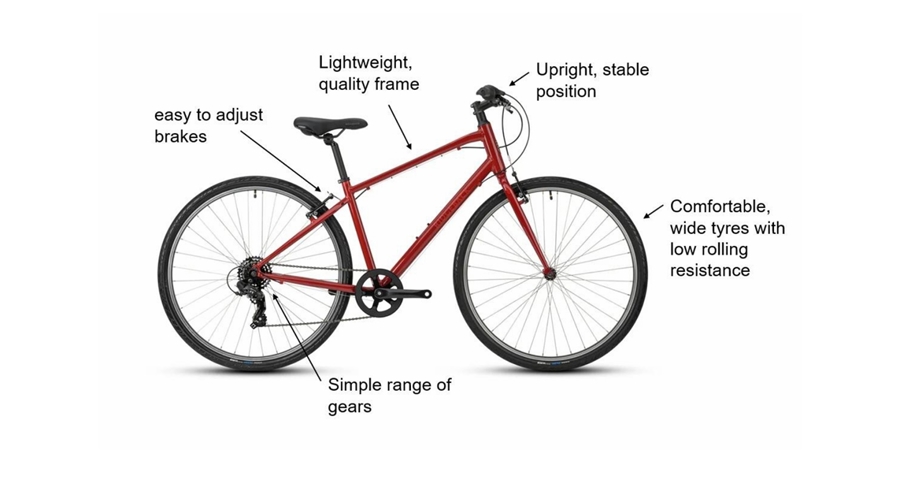
Hybrid bikes with flat bars generally offer the best balance of comfort and efficiency and are designed to be used on roads and surfaced paths and can accommodate mudguards.
Road bikes generally come with drop handlebars and are less suitable for use as fleet bikes.
Mountain bikes have large tyres, front and sometimes rear suspension and are designed for off-road use on rough tracks. In some rural settings mountain bikes with front suspension may be appropriate for use as fleet bikes but this is generally not the case, due to their additional weight and rolling resistance.
Weight
The lighter the bike, the more efficient and easier it is to ride. However, weight needs to be balanced with comfort and robustness. For instance, mudguards add weight but make the journey more comfortable in wet conditions.
Choose bikes with an aluminium alloy frame as they are durable and light weight.
Accessories like racks and panniers can be added to carry bags if necessary. Avoid unnecessary features like suspension that will increase the weight and cost.
Gears
With gears, simplicity is easier for new cyclists. Look for bikes with 8-11 gears or cogs on the rear wheel, ideally with just one gear lever. This is generally lighter, easier to maintain, and simpler for users.
Maintenance
Bike fleets require regular inspections, servicing, and maintenance. For this reason, it’s useful to keep things simple. Many bikes now come with hydraulic disk brakes – these require less frequent adjustment but are trickier to fix when something goes wrong. Rim brakes require more frequent adjustment but are easier to maintain. Avoid mechanical disc brakes as these require regular adjustment and are more difficult to maintain.
Quick release wheels will allow you to remove wheels easily for maintenance and to fix punctures. Avoid hub gears or coaster brakes as they make it harder to remove wheels.
Storage
Safe secure storage is essential for a bike fleet. When bikes are on loan, it is the responsibility of the user to store the bike in a safe and secure place. More information is available in our Cycle Storage and Parking Guidance.